Followership in Leadership
How walnut.coach helped Yakult — the iconic Japanese health and wellness company — explore the often-overlooked power of followership, challenge passive compliance culture, and build a more engaged, critically-thinking workforce.
- LeadershipWorkshop
- FollowershipFramework
- CultureFocus
- ICFCredentialed coaches
Leaders Who Needed Better Followers
Yakult came to walnut.coach with a nuanced leadership challenge — one that most organisations rarely name directly: the quality of their followers was limiting the quality of their leaders.
Passive Followership Was Holding the Organisation Back
Teams had skilled leaders, but followers who defaulted to compliance, agreement, and passivity. This created groupthink, reduced critical thinking, and limited the quality of decisions.
Groupthink Was Prevalent
Conformist and passive followers were agreeing with group decisions without genuine critical input. The result: consensus that masked poor decision-making.
Followers Didn't See Their Power
Most employees didn't realise that as followers, they had real influence, could shape leaders' views, and could even substitute for a leader when needed.
The Leadership-Followership Link Was Misunderstood
The relationship between leader and follower was seen as a hierarchy, not a dynamic partnership. This needed to be reframed.
Leadership-Followership Workshop
An interactive workshop exploring what followership actually means, how it shapes leadership, and how exemplary followers create better organizations.
- OpeningActivity
- Deep-DiveLearning
- LeadershipLink
- Four people each do something out of the box
- Others invited to join them one by one
- Leaders then switch groups
- Explore what makes people follow
- Understand different degrees of difficulty in following
What made this work
Three deliberate design choices transformed a workshop about power into a workshop about empowerment.
- 1
Making It Felt Before It's Explained
The 4-Leader activity made every participant feel the dynamics of followership in their body before a single slide was shown. This made the theory land deeply.
- 2
Reframing the Follower
The program systematically dismantled the idea that being a good follower means being passive. By the end, being an Exemplary Follower was something participants were proud to aspire to.
- 3
Connecting to Real Organisational Risk
The groupthink and passive compliance dynamics were tied directly to real business risks, making the program feel urgent and relevant — not abstract.
“I walked in thinking this was a leadership program. I walked out realising I'd been a passive follower for years — and that changing that was the most powerful leadership move I could make.”
What changed after the programme
Participants left with a new understanding of their role, their power, and their responsibility to the organization's decision-making quality.
A New Language for Teams
Teams gained a shared vocabulary for followership types. Managers began having different conversations — actively seeking out Exemplary Followers and creating conditions for critical thinking.
Reduced Groupthink Risk
Participants became more aware of conformist and passive tendencies in themselves and began to actively counteract them. Meetings got healthier and more honest.
Followers Who Felt Empowered
Employees who had previously seen themselves as "just" contributors understood that their critical thinking and honest challenge was not just welcome — it was essential.
Stronger Team Energy & Morale
The program gave people a new way to see their value and contribution, leading to higher engagement, better communication, and more ownership over outcomes.
From first call to follow-through
Every Walnut engagement follows the same five steps, run by ICF-credentialed coaches.
- 1
Discovery
Understanding the organisation's culture, challenges and people
- 2
Custom design
Tailoring content, examples and exercises to the team
- 3
Delivery
An interactive, gamified session with real-time engagement
- 4
Commitment
Each participant leaves with one action to try straight away
- 5
Follow-through
Ongoing coaching for deeper individual growth
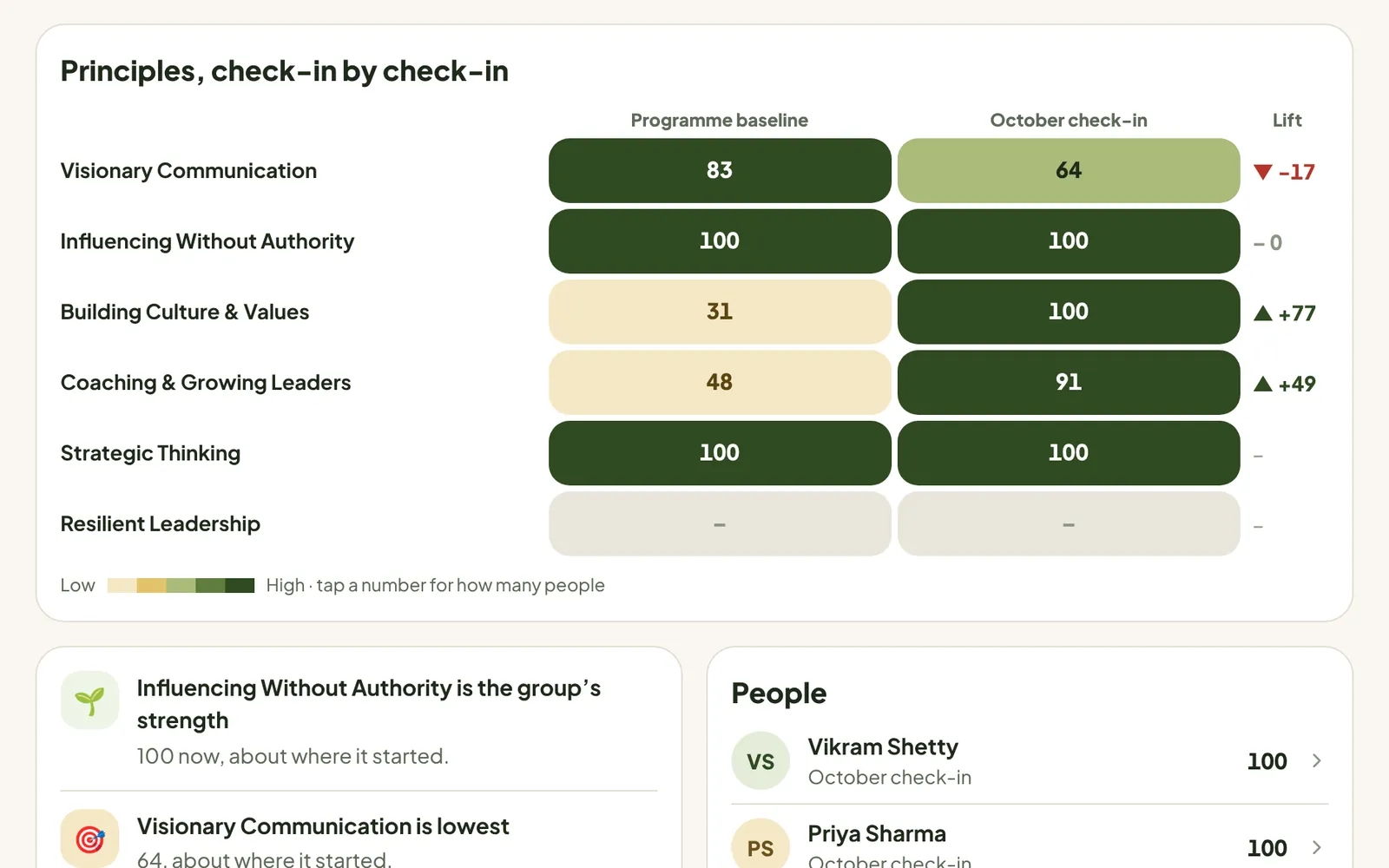
What HR sees in the app
Ready to build a thriving team?
Your programme starts with a conversation. Book a 30-minute call, or try the 7-minute game first.