Parimaarjan — First Time Managers Journey
How walnut.coach helped Saviynt — a global leader in identity security software — transform 50–100 high-performing individual contributors into confident, self-aware, and effective first-time managers through a comprehensive 6-month learning journey.
- 50–100First Time Managers
- 6Months Duration
- 3Camps + Coaching
- ICFCredentialed coaches
Saviynt's Best Individual Contributors — Unprepared to Lead
Saviynt, a global identity security powerhouse, faced a challenge every fast-scaling tech company knows: their most talented engineers and contributors were being promoted into management — without the mindset, tools, or frameworks to thrive in their new roles.
From Doer to Leader — Without a Map
Saviynt's first-time managers were skilled and driven — but they had been promoted for their individual performance, not their leadership capability. Managing people required a completely different skillset that no one had explicitly taught them, and the gap was showing.
Leadership Identity Had Not Been Built
New managers were still operating with an individual contributor mindset — solving problems themselves instead of developing their teams, measuring their value by output rather than by the growth of the people around them.
Feedback & Performance Culture Was Weak
Without the skills or confidence to have structured performance conversations, first-time managers avoided difficult feedback. Goals were set but not owned, and performance reviews were reactive rather than developmental.
Managing People Was Harder Than Managing Tasks
The emotional, interpersonal, and motivational dimensions of management — assertiveness, conflict, empathy, delegation — were unfamiliar territory. Managers needed frameworks for the human side of leadership, not just the process side.
Parimaarjan — The 6-Month Manager Journey
Named Parimaarjan — Sanskrit for transformation and renewal — this 6-month journey took first-time managers from confusion to confidence through three structured camps, cohort coaching, and a learning methodology built around doing, not just knowing.
- Month 1Base Camp — Foundation
- Month 3Advance Camp — Depth
- Month 5Leadership Basics — Mastery
- 3×Cohort Coaching Sessions
- Managing Self · Knowing the Role — why it exists, what would be lost without it, where it adds value
- Managing Self · Knowing Self — KSAOs (Knowledge, Skills, Abilities, Other Attributes)
- Managing Self · Prioritisation using the Urgent–Important Matrix
- Managing Self · Planning for the month, week, and day with intention
- Managing Self · Living Saviynt's Core Values as a Team Lead: Innovate, Customer Focus, Deliver Results, Respect, Accountability
- Managing Team · Inducting new team members — setting standards, sharing vision and values
- Managing Team · Being assertive — how and when to say No
- Managing Team · Influencing — understanding types of power; leveraging Expertise Power
- Managing Team · Building knowledge & skills through On-the-Job Training (OJT)
- Managing Team · Building positive outlook through coaching-based counselling (TEL methodology)
- Managing Team · Organising and conducting effective meetings — Inform, Influence, Get Ideas
- Managing Results · Using core management tools — Job Descriptions, KRAs, Feedback Systems, Appraisals
- Managing Results · Goal setting using the SMART framework
- Managing Results · Conducting a meaningful review meeting
- Managing Results · Creating healthy competition and appreciation within the team
- Managing Results · Cross-functional team development — "Catch someone doing something right"
- Cohort Coaching Session 1 — Peer-to-peer reflection on real management challenges following Base Camp
What made this work
This wasn't a management training course. Parimaarjan was a transformation journey — designed around the principles that create real, lasting change in how people lead.
- 1
Learning by Doing, Not Sitting
Every camp used a methodology built around doing: games, role-plays, case studies, and real-life scenario discussions. Managers didn't just learn about leadership — they practised it, made mistakes safely, and reflected on those mistakes with a coach by their side.
- 2
Built Over 6 Months, Not 6 Hours
Lasting leadership capability isn't built in a day. The 6-month arc gave managers time to apply each camp's tools in the real world, return to the next camp with lived experience, and build layer upon layer of capability — rather than forget everything by Monday.
- 3
Cohort Coaching as the Glue
The three cohort coaching sessions held between camps were where the deepest learning happened. Managers brought real problems, got peer perspectives, and held each other accountable. The cohort didn't just learn together — they became each other's first line of leadership support.
“Parimaarjan didn't just teach our managers tools — it changed how they think about their role. By the end of the journey, they weren't just managing their teams; they were genuinely developing them. That shift is irreversible.”
What changed after the programme
Across 50–100 first-time managers at Saviynt, the 6-month journey produced a measurable shift — not just in individual capability, but in how teams performed, how feedback flowed, and how the organisation's management culture evolved.
Genuinely Self-Aware Managers
The Johari Window, SMART frameworks, and structured self-reflection built real self-awareness — not just intellectual knowledge of it. Managers understood their strengths, blind spots, and patterns under pressure, and had tools to keep improving with or without a program.
Stronger Team Performance
Teams managed by Parimaarjan graduates showed visible improvement in coordination, accountability, and output. Managers who had learnt to delegate, develop, and direct situationally created teams that outperformed expectations — not because of harder pushing, but because of smarter leading.
Feedback Became a Habit, Not an Event
Using the SBI model and two-way feedback frameworks, managers began having regular, structured, honest performance conversations. What had previously been an annual anxiety became a daily discipline — and the quality of team relationships improved as a result.
Confident, Decisive Leadership
The Decision-Making module, combined with Situational Leadership and BATNA negotiation training, gave managers the frameworks to act with conviction — even in grey areas. Leaders stopped escalating every ambiguous decision and started owning them, earning trust from above and below.
From first call to follow-through
Every Walnut engagement follows the same five steps, run by ICF-credentialed coaches.
- 1
Discovery
Understanding the organisation's culture, challenges and people
- 2
Custom design
Tailoring content, examples and exercises to the team
- 3
Delivery
An interactive, gamified session with real-time engagement
- 4
Commitment
Each participant leaves with one action to try straight away
- 5
Follow-through
Ongoing coaching for deeper individual growth
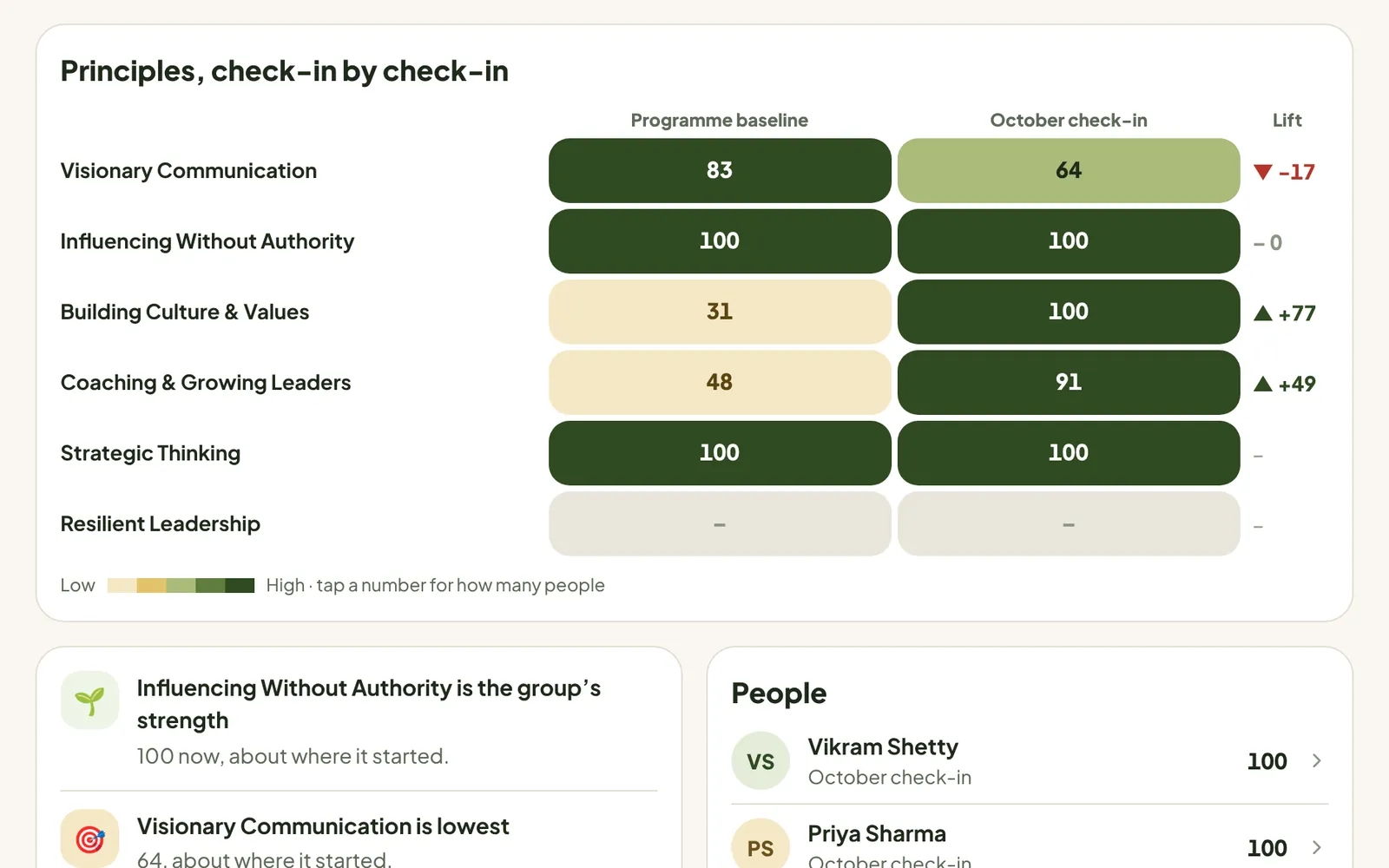
What HR sees in the app
Ready to build a thriving team?
Your programme starts with a conversation. Book a 30-minute call, or try the 7-minute game first.