Accountability & Ownership Program
How walnut.coach helped Atotech — a global specialty chemicals and equipment company — build a deep culture of accountability, reduce the bystander effect, and develop employees who take genuine ownership through the immersive So Farm, So Good gamified experience.
- ImmersiveGame
- 8+Mental Models
- AccountabilityFocus
- ICFCredentialed coaches
A Technical Team Struggling with Ownership & Accountability
Atotech came to walnut.coach with a fundamental cultural challenge: a capable team where accountability was assumed rather than practised, and where learned helplessness and bystander behaviours were creating invisible drag on performance.
Accountability Was Talked About, Not Lived
Employees were hardworking and skilled — but the culture of taking proactive ownership, raising issues, and following through without being chased was not yet embedded. The gap between knowing and doing was wide.
The Bystander Effect Was Pervasive
When something was nobody's explicit job, it became nobody's problem. Gaps fell through the cracks because everyone assumed someone else would handle it.
Learned Helplessness Had Set In
Some employees had internalised a belief that their actions didn't matter much in the larger system. Initiative felt risky; waiting felt safer.
Systems Thinking Was Missing
Teams were optimising their own domains without understanding how their actions affected others upstream and downstream. There was no shared sense of the whole.
Accountability & Ownership Program
An immersive gamified experience anchored by the So Farm, So Good game — where employees learn ownership, systems thinking, and accountability by actually experiencing the consequences of their choices in real time.
- So FarmGame
- 8+Mental Models
- OwnershipCommitments
- Be a villager for 2 years — make farming decisions under uncertainty
- Plan ahead, generate produce, aim for a happy profit
- Experience how personal choices affect the entire system
- Mental models woven in: RACI, Systems Thinking, Bystander Effect
- DRI (Directly Responsible Individual), Entropy, Murphy's Law
What made this work
We don't lecture about accountability. We create experiences where accountability becomes visceral and impossible to ignore.
- 1
A Game That Makes Accountability Unavoidable
So Farm, So Good puts every player in a position where their choices have direct consequences — for themselves and for the group. There's no hiding behind process. Accountability becomes visceral.
- 2
Mental Models That Transfer
By debriefing the game through RACI, Dunning-Kruger, Murphy’s Law, and the Bystander Effect, the program gave participants frameworks they could apply to their real work the next morning.
- 3
From Self-Awareness to System Awareness
The game built not just individual accountability but systems thinking — understanding how your actions ripple through the whole organisation, not just your own corner of it.
“The So Farm game showed me exactly where I was being a bystander in my own team. By the end of the debrief, I had already decided three things I was going to change the moment I got back to my desk.”
What changed after the programme
Atotech employees emerged with a genuine shift in how they thought about their work — from passive compliance to proactive ownership and accountability.
A Culture Shift Toward Ownership
Employees who had previously waited to be asked began initiating. Bystander moments became visible and callout-able — because the team now had shared language for them.
Better Cross-Team Collaboration
Systems thinking opened eyes to how individual actions affected others. Teams began communicating earlier, flagging issues proactively, and coordinating more intentionally.
Creative Problem-Solving
The game environment normalised experimentation and learning from failure. Teams transferred this mindset back to their work — trying new approaches rather than defaulting to safe routines.
Stronger Ownership Culture
Participants reported a genuine shift in how they thought about their work. Ownership stopped feeling like a burden and started feeling like a source of agency and pride.
From first call to follow-through
Every Walnut engagement follows the same five steps, run by ICF-credentialed coaches.
- 1
Discovery
Understanding the organisation's culture, challenges and people
- 2
Custom design
Tailoring content, examples and exercises to the team
- 3
Delivery
An interactive, gamified session with real-time engagement
- 4
Commitment
Each participant leaves with one action to try straight away
- 5
Follow-through
Ongoing coaching for deeper individual growth
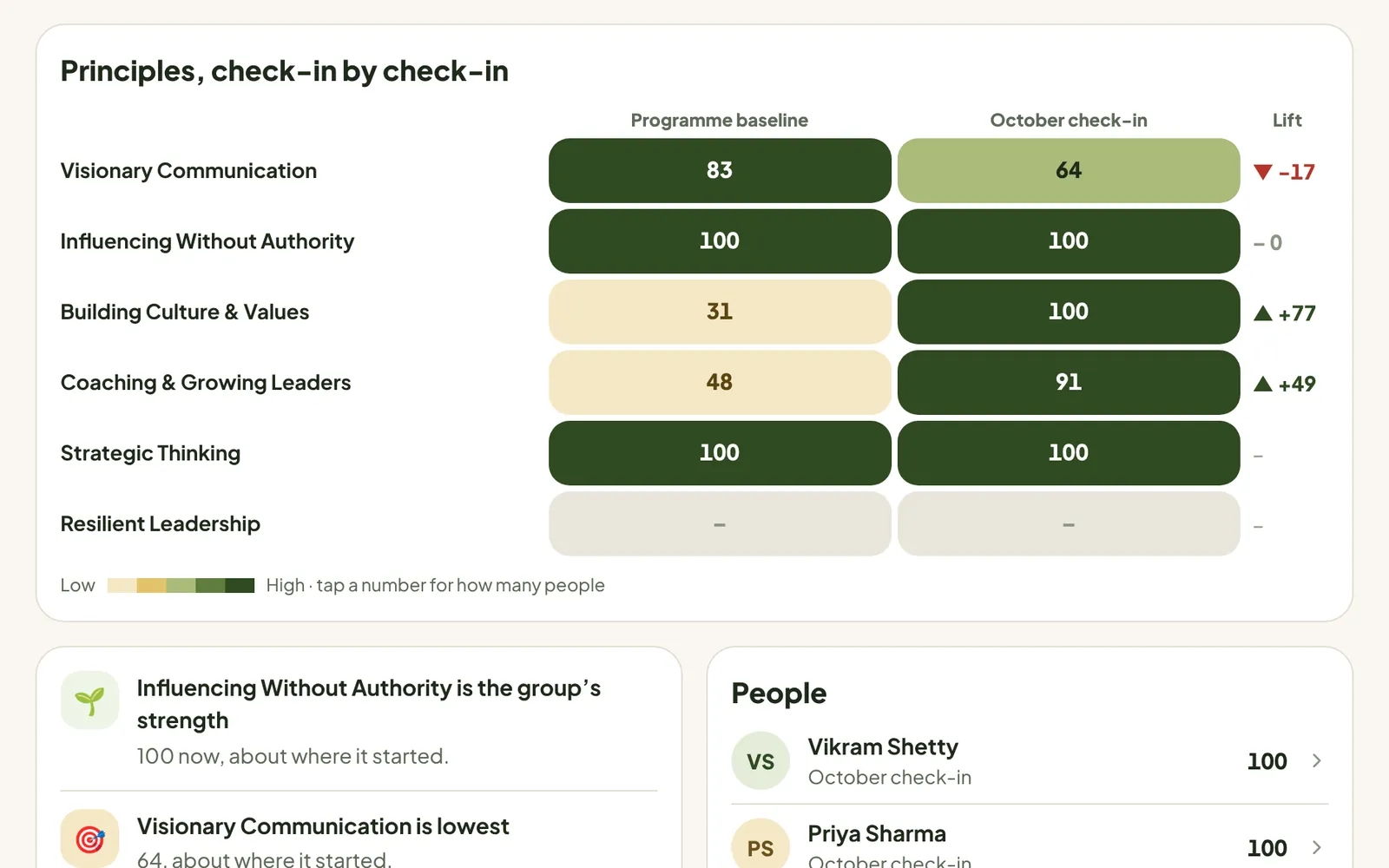
What HR sees in the app
Ready to build a thriving team?
Your programme starts with a conversation. Book a 30-minute call, or try the 7-minute game first.